Learning P.E.A.C.E.™ in School
Learning Personal Empowerment I Awareness I Conflict Expertise
A Cloud Program on UnitusTI
We need more than inspiration to change the growing division and violence in our schools and communities. We need practical tools, clear structure, and a shared foundation for how to live and work well together.
Learning P.E.A.C.E. equips students, educators, and school communities with the awareness, relational capacity, and conflict engagement skills required to navigate real-world challenges with clarity, accountability, and respect.
An Education in Living Well Together
Learning P.E.A.C.E. builds the foundation for mutual respect, self-awareness, social mastery, and constructive conflict engagement across entire school communities—students, educators, and parents alike.
As a structured, comprehensive international curriculum developed in real classrooms, Learning P.E.A.C.E. has been refined across diverse school systems. It began in response to a tragic act of school violence—the death of a child due to bullying—which exposed the urgent need for practical, human-centered tools to address how students relate, react, and engage with one another.
What started with one teacher in Nova Scotia has grown into a scalable program that has transformed hundreds of lives and is now accessible to schools worldwide through the UnitusTI cloud platform.
Technology is shaping how students think, relate, and communicate—and not always for the better. Constant digital input has increased disconnection, reactivity, and confusion in how young people engage with themselves and others.
Learning P.E.A.C.E. uses technology intentionally—as an effective delivery tool to strengthen the human capacities that technology cannot teach—creating more focused classrooms, stronger relationships, and a healthier school environment.
What makes this program unique
Three facets address a world of ever-increasing violence:
- Pro-active: Learning P.E.A.C.E. does not focus solely on eliminating negative behavior. It develops the skills required to engage constructively from the outset—reducing escalation before it begins.
- Comprehensive: The program builds a complete set of relational and behavioral skills, consistently applied across ages and settings. Students learn what is expected, how to respond, and how to work through real differences with clarity and respect.
- Universal: Non-prescriptive and culturally adaptable, Learning P.E.A.C.E. is grounded in shared human values. Its process-oriented approach allows it to be integrated across diverse educational, cultural, and social environments.
Prevailing Problems in Schools Today:
These are not isolated issues—they are systemic and increasing:
- Disciplinary difficulties
- Lost classroom, teaching time
- Disruption in the classroom
- Varied and inconsistent problem solving measures
- Students not adhering to behavioural guidelines
- Acted out aggression in the classroom and on the playground
- Name calling, discrimination, attacks
- Intolerance of differences
- Exclusion
- Lack of human understanding and empathy
- Children’s fear of aggression and violence
Learning P.E.A.C.E. Program Outcomes:
These outcomes are observable, practiced, and measurable in daily school life:
- Collectively practiced problem solving skills
- Trained self-discipline
- Clear rules and consequences
- Understanding and accepting different ways of thinking, being and acting
- Helpfulness
- Human understanding and empathy
- Sense of belonging / Team spirit
- Feeling safe and secure at school
- Effective and enjoyable lessons
- Effective teaching and learning
- A pleasant working and learning atmosphere
- A positive school reputation
The Building Blocks of Learning P.E.A.C.E.
Being comprehensive and pro-active, universal, non-prescriptive and effective prove this program to be outstanding in the field of life skills and violence prevention.
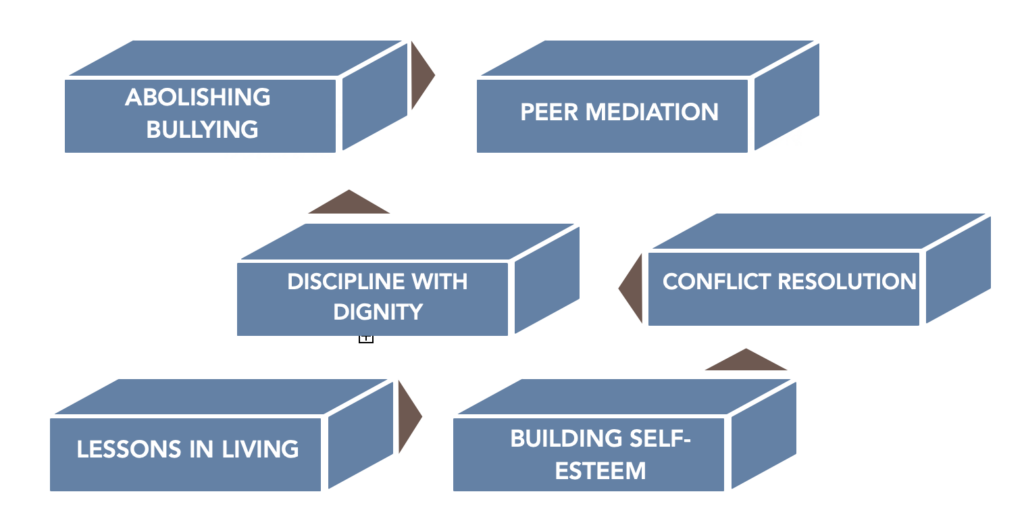
Lessons in Living
Children and teenagers are enabled to live well with one another, be responsible and express their natural joy. Diversity, inclusion, teamwork, and nonjudgment are learned here. Living well with oneself and with others is the foundation of living a life worth living.
Building Self-Esteem
Self-respect, recognizing and accepting strengths and weaknesses, and improved self-worth are characteristics that are developed by using easy to apply strategies in any group setting. Self-worth is the foundation for creating peaceful relationships.
Discipline with Dignity
Children and teenagers are equipped with ideas and strategies to develop cooperative behavior and the desire to adhere to collective rules and guidelines. Techniques used retain and honor the dignity of each individual, child and adult alike.
Conflict Resolution & Violence Prevention
Equipping children and teenagers with tools for positive social interaction relieves them of stress in difficulties and helps diffuse most conflict situations. Impulsive, aggressive, and problematic behavior is transformed by training in communication, empathy, conflict resolution, and anger management.
Abolishing Bullying
The focus here is developing social competency, sensitizing children to aggression and educating them in what bullying is and the many forms it takes. Children and teenagers are enabled to recognize and reroute their own aggressive impulses as well as to deal with the aggression of others. Since bullying is the spring board for most violence, recognizing aggressive behavior and learning strategies to deal with it are of utmost importance.
Peer Mediation
Teachers as well as students are trained in mediation in order to assist all students in conflict resolution. The youth trained are then skilled to mediate conflict among their peers without the direct intervention of an adult. Peer Mediation is an outstanding process to help minimize aggression and violence in schools.
Proactive. Comprehensive. Regenerative.
Learning P.E.A.C.E. is not a trend or a supplemental program. It is a foundational system that addresses the human skills modern education often assumes but does not explicitly teach.
It can be implemented across schools, organizations, and institutions seeking to strengthen behavior, improve learning conditions, and prepare young people to participate responsibly and effectively in the world they are entering.